Civil commitment team gives clients a voice
When a college student, home on holiday, was brought to the hospital during a mental health crisis, her options seemed daunting. Medical staff were recommending she be civilly committed. Despite years of struggling with her mental health, she’d never been committed. She’d been taking her medications, and she was doing great in school.
She was scared. This one moment could derail all those years of hard work.
But because she was in Hennepin County, she had access to an attorney at ARS to help her navigate the legal hurdles ahead. And that lifeline made all the difference.
“She was able to work with the hospital, work with me, and ultimately accepted a less restrictive mental health supervision,” said ARS Senior Attorney Katie Hansel. “We resolved her case with a stay of commitment, and after 90 days it was dismissed because she did so well. She stabilized, returned to school, and graduated.”
In Minnesota, a person experiencing a mental health or chemical dependency crisis can be held involuntarily if there are safety concerns. It starts with a petition to the court. A judge can order the civil commitment if there’s clear and convincing evidence that the person poses a risk of harm due to mental illness, developmental disability, or chemical dependency. All less restrictive options, like voluntary admission or community treatment, must be ruled out first.
Most commitments are temporary—up to six months—and start with an emergency hospital visit. The aim is to get the person stabilized so they can return home.
The less common “indeterminate” commitments generally involve secure, long-term facilities, and are reserved for individuals deemed mentally ill and dangerous, sexually psychopathic, or sexually dangerous.
Regardless of the underlying issues or the length of commitment, anyone facing civil commitment in Hennepin County is entitled to an attorney from ARS.
ARS launched its civil commitment team in 2023. Today, the team has more than 20 attorneys who have handled more than 2,500 court matters.
“People’s fundamental rights are at stake,” said ARS Senior Attorney Ethan Scrivner. “It’s vital that we hold the system to the same level of seriousness we expect in any case where someone’s liberty is on the line.”
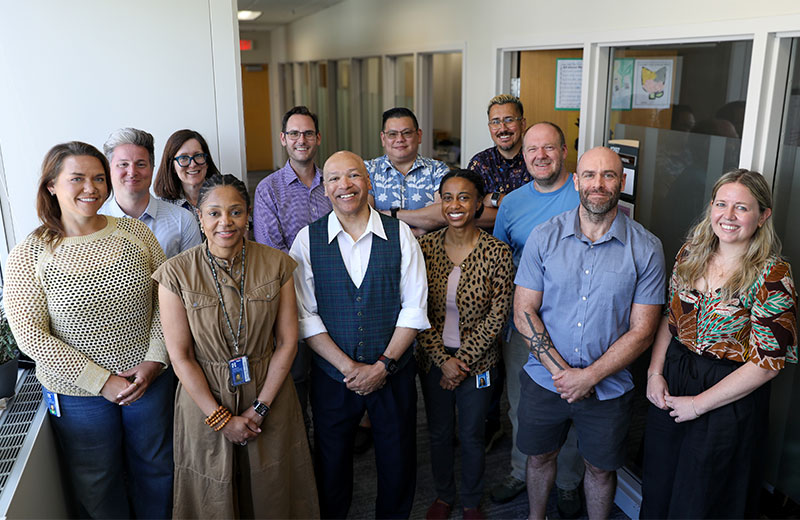
Members of the ARS civil commitment team.
Digging deeper helps the courts and the clients
Civil commitment petitions tend to be based on quick evaluations. ARS attorneys get involved immediately, often meeting with clients during their initial hospital stay to understand the client’s goals, explain the process, and determine next steps.
By speaking with family members, examining medical histories, and challenging assumptions, ARS legal teams can provide information to the court that gives the full picture of a client’s situation. This had led to more effective treatment and better outcomes for clients.
“Some exams for determinate cases last 10 or 15 minutes,” said Senior Attorney Chantell Higgins. “We’re helping the courts come to the right decision by digging a little deeper.”
This approach has also prevented some commitments that would have been wholly improper.
One client was taken to the hospital after reporting a traumatic incident, but her report was dismissed by medical staff as delusional. Her attorneys at ARS found police records confirming her account of the incident. A commitment was avoided in lieu of more appropriate mental health support.
In another case, the state sought to commit a client as “mentally ill and dangerous” until ARS provided evidence that substance use disorder was the primary driver of his behavior. The client instead received a shorter-term commitment, with treatment focused on his substance use.
“Had he been committed [as mentally ill and dangerous], he could have gone to a secure mental health facility for the rest of his life,” Scrivner said. “Their programming is not tailored to people with substance use disorders—it’s for people with severe, persistent mental illness.”
Holistic services help clients find stability, agency
ARS handles commitment cases with the same holistic, person-centered approach it uses across practice areas.
Individuals facing commitment sometimes have overlapping legal issues, like housing or child protection. ARS attorneys collaborate with each other and work closely with a holistic services team to tap into the client’s support system and explore alternative, community-based options. ARS also continues its representation regardless of how long a person is committed.
Addressing the client’s needs holistically gives them a better chance at lasting stability and success.
“A lot of our clients are in a position where other people think they know what’s best for them,” Hansel said. “Taking away that decision-making ability from someone is a big deal, so we’re giving them whatever agency we can in those situations.”
Published 8/28/2026