
Find a new perspective in the Government Center
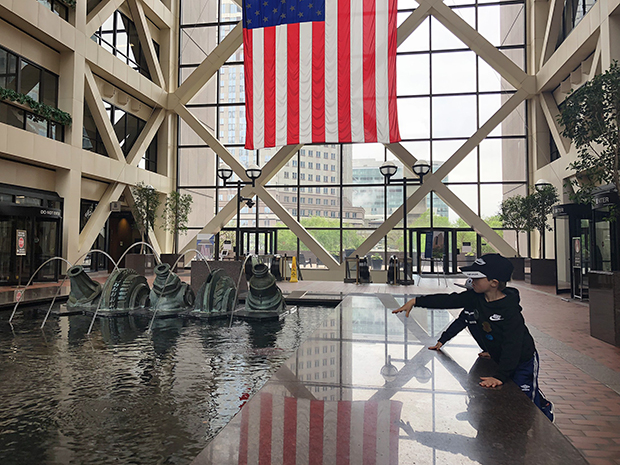
Come inside the Hennepin County Government Center. Take in the soaring 23-story atrium, interior skyways, super-sized flag and four-season indoor gathering space, and don’t forget to look outside.
That advice comes from Jennifer Yoos, head of the School of Architecture at the University of Minnesota, who notes that the 1977 tower’s orientation and what goes on outside are as much a clue to its modernist/contextualist architecture as its carnelian red granite façade and expanses of glass.
To the north, she urged, notice how the 23-story bank of windows perfectly frames the 1906 City Hall. Think about the ways that people have filled the space below with protests and news conferences, civic-oriented activities to engage and draw the attention of their local government leaders.
To the south, note the structural green space and sunny stair landing. Imagine the picnics, markets and celebrations that people have enjoyed there, and take in the smooth granite berms that invite walkers into the space and attract skateboarders from around the nation, to the chagrin of security and facilities staff.
A modern design, in context
As a pioneer in the contextualist movement in the late 1960s and early 1970s, architect John Carl Warnecke was interested in how the landmark building would work within its environment.
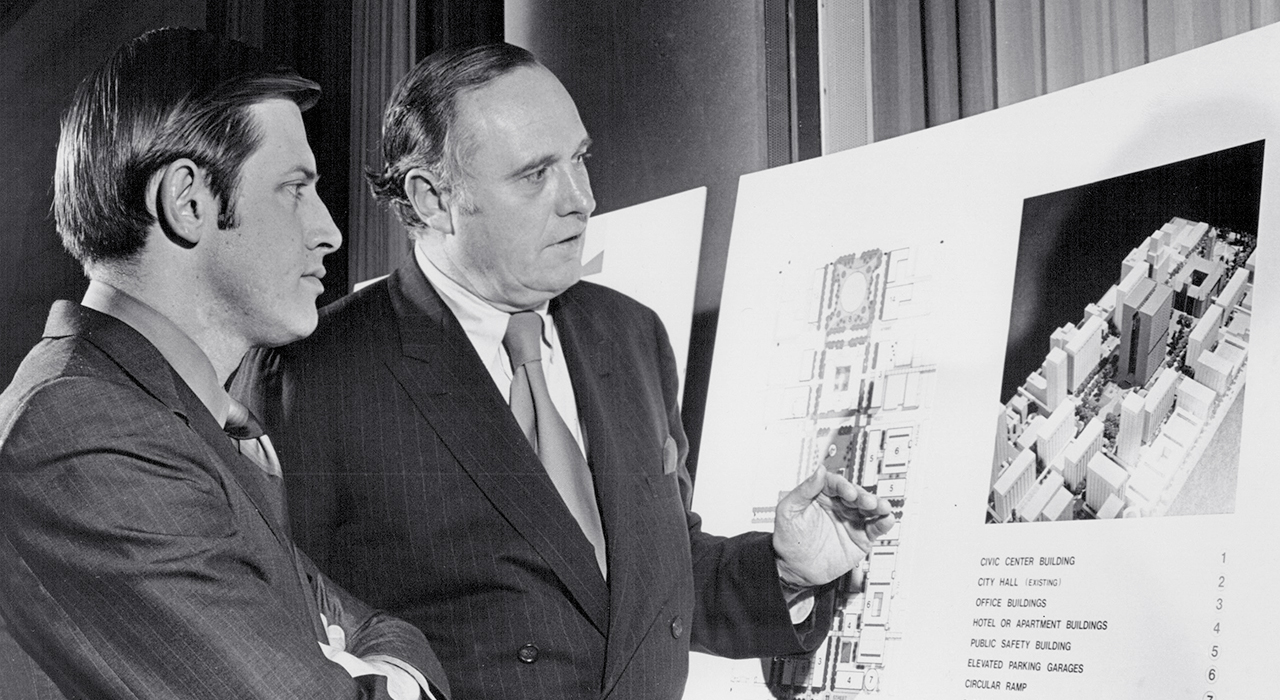
Architect John Carl Warnecke (right) and County Commissioner Thomas L. Olson.
“A lot of his work is about courtyards and park space as much as it is the building,” Yoos said. “The context the tower creates is essential. It is part of a community of buildings connected on the ground level and skyway levels with public space. The design considers what kinds of public spaces are needed and sets up what happens there around the seasons.”
The building’s position straddling 6th Street “breaks the grid” of city streets, emphasizing its significance downtown. But in other ways, it is very much a part of a larger downtown Minneapolis ecosystem.
Note that its façade is the same red carnelian granite (mined near Ortonville, Minn.) as City Hall, though it is burnished, not rubble-faced. Walk around downtown Minneapolis and notice that the same or similar stone is all over, as sidewalk panels, as planters and on the faces of other buildings, old and new.
In addition, Yoos noted, the placement and orientation of the building, with its tall bank of multistory windows facing north and south, made good use of natural light for the benefit of daytime office workers, and the smaller windows on the east and west sides probably minimized loss of heat in the winter.
Blending in was a controversial move in some circles of Warnecke’s contemporaries, who believed that modern buildings should stick out and never assimilate.
Find a new point of view
When we take in very visible buildings like the Government Center, we often treat them as decorative objects we either like or don’t like, she noted. But it’s good to view a building from multiple views, inside and out, above and below, to consider how it makes use of light and social spaces, and “how it makes you feel and connect to other people,” she said.
“It’s not just style, or its appearance and who designed it,” Yoos said. “That doesn’t matter as much as the building’s use and the place it creates. They’re there and then they’re gone; the architecture really matters more than the architect. The building’s success is about how it makes part of a city and its civic experience, and how it helps you understand your government and how it works.”