
Environment
Rural and agricultural land management
Hennepin County, in coordination with state agencies and programs, provides funding and technical assistance to landowners managing agricultural, large lot, and rural land.
Learn about your land using the natural resources interactive map. In the map, you can select data layers to see existing conservation easements and some land designations including ecologically significant areas and natural resources corridors.
Buffers and ditches
About the buffer law
Minnesota's buffer law requires perennial vegetative buffers along lakes, rivers, streams, and ditches to protect water quality by filtering out phosphorus, nitrogen and sediment.
A buffer is vegetated land adjacent to a stream, river, lake or wetland. Buffers help slow the flow of water and filter out phosphorous, nitrogen, and sediment, which are all pollutants that degrade water quality.
Hennepin County has effectively achieved 100% compliance with the buffer law. The county continues to monitor to ensure compliance with the buffer law, especially when property transfer occur.
Buffer law requirements
The law includes the following requirements:
- Buffers an average of 50 feet and minimum of 30 feet must be installed along public waters
- Buffers a minimum of 16.5 feet must be installed on public drainage systems
- Buffers must be permanently vegetated and not contain noxious or prohibited weeds
The Minnesota Board of Water and Soil Resources oversees implementation of the buffer law. Buffer program.
The Minnesota Department of Natural Resources created buffer maps that determine which waters are subject to the requirements. Buffer mapping project.
Implementation
Staff are available to assist landowners with staking of buffers, enrolling in conservation programs, and determining what to plant in the required buffer area.
If you would like to request a validation of compliance for any reason, email or mail the validation of completion form (DOCX, 1MB) to Roz Davis at rozalyn.davis@hennepin.us or
Hennepin County Environment and Energy
Attn: Roz Davis
701 4th Ave S, Suite 700
Minneapolis, MN 55415
Maintaining and improving buffers
There are many things you can do to maintain and improve buffers once they are in place. Use the following factsheets from the Minnesota Board of Water and Soil Resources to extend the lifespan and improve the environmental impacts of buffers.
- Buffer maintenance (PDF, 2MB)
- Buffers for clean water (PDF, 3MB)
- Buffers for wildlife (PDF, 3MB)
- Forested buffers (PDF, 2MB)
- Alternative practices for buffers (PDF, 2MB)
Inspections
The Minnesota Board of Water and Soil Resources (BWSR) requires that all parcels requiring buffers be reviewed at least once every three years. Parcels are reviewed by aerial photo, and spot checks must be conducted on 15 percent of parcels.
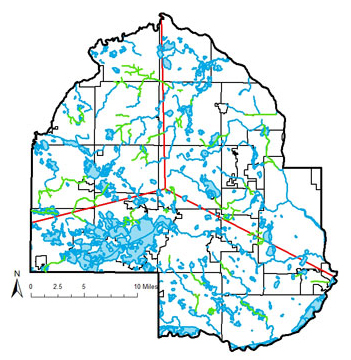
To fulfill this mandate, Hennepin County staff will review aerial photos of parcels requiring buffers in one-third of the county each year. Additionally, spot checks will be conducted in the field on 5 to 10 percent of the reviewed parcels each year. Residents whose parcels will be spot check will be notified via letter.
The map shows the parcels that require buffers and how the county will be divided into thirds for inspections. The colors on the maps indicate:
- Blue lined waters are public waters requiring 50-foot buffers
- Green lines are public ditches requiring 16.5-foot buffers
- Red lines are the sections of the county that will be reviewed on a three-year cycle
For more information
Contact Roz Davis at rozalyn.davis@hennepin.us with questions or for more information.
Minnesota agricultural water quality certification program
This is a voluntary opportunity for farmers and agricultural landowners to take the lead in implementing conservation practices that protect water. Those who implement and maintain approved farm management practices will be certified and in turn obtain regulatory certainty for a period of ten years.
Minnesota Agricultural Water Quality Certification Program
Through this program, certified producers receive:
- Regulatory certainty: certified producers are deemed to be in compliance with any new water quality rules or laws during the period of certification
- Recognition: certified producers may use their status to promote their business as protective of water quality
- Priority for technical assistance: producers seeking certification can obtain specially designated technical and financial assistance to implement practices that promote water quality
If you're interested in getting certified, contact Roz Davis at rozalyn.davis@hennepin.us.
Agricultural inspection programs
Inspection, registration, and management programs
Hennepin County administers numerous agricultural registration, inspection, and management programs, including:
- Biological control programs for terrestrial invasive species such as purple loosestrife and leafy spurge
- Seed inspection and seed sampling
- Fertilizer registration inspection and sampling
- Pesticide licensing and registration inspections
- Pesticide applicator inspections
- Waste pesticide collections
- Empty pesticide container collections
- Enforcement of the Minnesota noxious weed law
Noxious weeds
Noxious weeds are plants that are injurious to public health, the environment, public roads, crops, livestock and other property. Prohibited noxious weeds must be controlled or eradicated as required in Minnesota Statutes, Chapter 18 section 18.78. Each city in Hennepin County has one or more local weed inspectors. For more information about noxious weeds in your city, or to report noxious weeds, contact your local weed inspector.
For more information regarding the county-wide administration of these programs, please contact the county agricultural inspector at 612-348-4659.
Chemigation permits
All growers who apply fertilizer (fertigation) or pesticide through an irrigation system that is connected to a water supply must obtain a chemigation permit from Minnesota Department of Agriculture prior to chemigating. For more information or to apply for a permit, please contact MDA Chemigation permits at 651-201-6057 or visit MDA's chemigation permit program page.
Get email updates
Get conservation news, funding, and events in rural Hennepin County, Minnesota.
Update your subscriber preferences