
Projects and initiatives
Opioid response
Our community is facing an opioid crisis. In 2024, more than 10,000 emergency room or hospital visits involved opioids, and 264 lives were lost to opioid-related overdoses. A big reason for the rise in these deaths is the spread of fentanyl and fentanyl-laced drugs. In 2024, fentanyl was involved in over 91% of opioid-related deaths in Hennepin County.
Understanding the risks of opioids, especially fentanyl, can save lives.
Data and understanding the opioid epidemic
Opioid data dashboards
Opioid-related deaths
Hennepin County's opioid-related death definition includes all deaths where any type of opioid (natural, synthetic or in combination) was a cause or contributing cause of death. This data dashboard uses publicly available data, updated annually (current 2023).
Opioid-related deaths of county and state residents data - Power BI dashboard
Opioid-involved hospital and emergency visits
The interactive data dashboard shows substance involved emergency and hospital visits in the 7-county metro area. It uses real-time electronic health record data, updated quarterly.
Substance involved emergency and hospital visits in Hennepin County data - Power BI dashboard
Health trends across communities in Minnesota (HTAC)
The HTAC dashboard displays prevalence estimates for over 30 health conditions (including opioid-use conditions). It uses electronic health record data, updated annually.
Dashboard comparison
The following document helps explain when to use the Substance involved emergency and hospital visits dashboard and when to use the HTAC dashboard:
Substance use-related healthcare / HTAC data comparison (DOCX 1MB)
Opioid overdose deaths remain elevated in Hennepin County
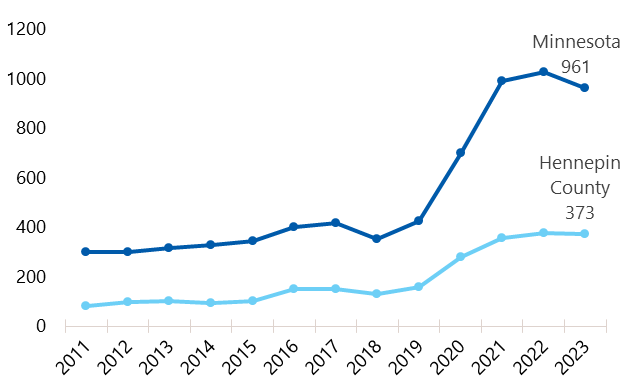
Opioid-related deaths decline in Minnesota, but Hennepin County deaths remain elevated.
Source: Minnesota death certificates, MDH. 2022-2023 data are preliminary; Hennepin County geocoded death data, CDC.
Most opioid overdoses involve fentanyl
Fentanyl is a prescription opioid that's also made and sold illegally. It's up to 50 times stronger than heroin and up to 100 times stronger than morphine. Fentanyl is driving recent increases in opioid overdose deaths. People may not know they're taking fentanyl because it's mixed into fake pills and other drugs. Fentanyl can be addictive and deadly, even in small amounts.
Opioid-related deaths involving fentanyl in Hennepin County

Source: Hennepin County geocoded death data, CDC.
Opioid effects are worse for some groups
The opioid epidemic impacts people from all walks of life, but disproportionately affects certain groups.
In Minnesota, American Indian people and African American people experience higher rates of opioid-related deaths and hospitalizations.
These differences are influenced by disparities in the social determinants of health, such as housing, food, healthcare, and economic well-being.
The bigger picture, non-fatal overdoses
Overdose deaths are only a part of the picture. Non-fatal overdoses, hospitalizations, injuries, and trauma are all preventable harms related to the opioid epidemic.
For more information, visit the Minnesota Department of Health's opioid overdose prevention page.
Hennepin County's response
Hennepin County's approach recognizes that the opioid epidemic is complex and requires a multi-faceted health and safety response.
Our response
To date, the following work has been accomplished:
Prevention
- Developed an opioid data collection and sharing tool
- Supported and obligated providers to use best practice prescribing guidelines
- Promoted safe storage and environmentally-sound disposal
Response
- Ensured all first responders, necessary county employees and targeted stakeholders have access to and training to administer naloxone
- Coordinated two county operated safe syringe services and naloxone distribution
Treatment and recovery
- Implemented substance use disorder (SUD) reform in Hennepin County
- Sought new state and federal opioid grant opportunities
- Ensured contracts have medications for opioid use disorder (MOUD) accommodations
- Increased treatment options (MOUD) and transition planning in correctional settings and throughout county clinical settings
Eliminating disparities
- Increased external and internal substance use disorder (SUD) data infrastructure
- Launched multi-year contracts with community organizations who provide culturally relevant response and prevention services to American Indian, African American, unsheltered homeless, and Somali/East African communities
Learn more about the strategic framework
- 2024 Opioid prevention strategic framework (PDF, 1 MB)
- 2024 Opioid stakeholder engagement report (PDF, 1 MB)
- 2024 Opioid prevention community partners (PDF, 1MB)
- 2024 Opioid prevention county provided services (PDF, 1MB)
- 2018 Opioid prevention strategic framework- strategy and pillars (PDF, 1MB)
- Study: Criminal Justice System as a Point of Intervention to Prevent Opioid-related Deaths, 2018 (PDF, 1 MB)
- Amended Minnesota Opioids State-Subdivision Memorandum of Agreement (state.mn.us)
- Hennepin County annual update for municipalities, 2025 recording/slides (PDF, 4MB)
- Hennepin County Opioid Framework Overview for Municipalities Public Meeting recording, 2025 (YouTube)
Printable overview in English, Spanish, Somali, and Hmong
English - Hennepin County opioid resources (PDF, 1MB)
Espanol (Spanish) - Recursos para opioides del condado de Hennepin (PDF, 1MB)
Hmoob (Hmong) - Kev pab txog tshuaj loog opioid hauv Cheeb Nroog Hennepin (PDF, 1MB)
Soomaali (Somali) - Tasiilaadka Maandooriyaha ee Degmada Hennepin (PDF, 1MB)
Safe storage and disposal
Safe storage and disposal prevents people from accessing medications that weren't prescribed to them. Protect your friends and family with these precautions:
The Hennepin County Sherriff's Office (HCSO) distributes free medication disposal bags at their office locations and by mail. They also host naloxone trainings. Learn more about opioid overdose prevention.
Overdose response and harm reduction
Naloxone (or Narcan)
Naloxone (or Narcan) is a medicine that can reverse opioid overdoses. Find naloxone near you with NaloxoneFinder.
Syringe services programs
Syringe services programs prevent the spread of infectious disease and overdose deaths by providing:
- Education about overdose prevention and harm reduction
- Access to naloxone, syringes, and other safer-use supplies
- Disposal of syringes and medications
- Vaccination, testing, and treatment resources for HIV and hepatitis B and C
- Referrals to health care and substance use treatment services
Learn more about syringe services programs:
Treatment and recovery
Substance use disorder is treatable, and recovery is possible.
- Search substance use service openings on Fast-Tracker
- Find medication for opioid use disorder services
If you are a provider, please visit information for mental health and substance use service providers.